
Jupiter: Giant Planet
12 Pages
English
High School
Edit
Jupiter’s Place in Space
1. Jupiter: The Solar System’s Giant
2. A World Beyond the Asteroid Belt
3. Immense Size and Powerful Gravity
4. A Fast-Spinning Planet on a Long Journey
5. Cloud Belts, Zones, and Giant Storms
6. Deep Layers and Jupiter’s Hidden Heat
Jupiter’s Features and Exploration
7. The Great Red Spot and Jupiter’s Stormy Atmosphere
8. A Vast Magnetic Field and Brilliant Auroras
9. Jupiter’s Faint Ring System
10. The Galilean Moons: Four Different Worlds
11. Jupiter’s Smaller Moons and Their Clues
12. Spacecraft Exploring Jupiter’s Future
1. Jupiter: The Solar System’s Giant
Jupiter is the fifth planet from the Sun and the largest world in the Solar System. It is a gas giant, meaning it has no solid surface like Earth’s; instead, its visible “surface” is the top of a deep, swirling atmosphere. Jupiter is made mostly of hydrogen and helium, the same light elements found in the Sun. Its enormous gravity has helped shape the Solar System by influencing the paths of asteroids and comets. Jupiter also has faint rings, a powerful magnetic field, and a large family of moons, making it a complex planetary system in its own right. Spacecraft observations continue to reveal details hidden beneath its clouds.
Fullscreen
2. A World Beyond the Asteroid Belt
Jupiter travels around the Sun beyond the main asteroid belt, between Mars and Saturn. Its average distance from the Sun is about 778 million km, or 5.2 astronomical units, so sunlight at Jupiter is much weaker than it is on Earth. From this distant position, Jupiter acts as a major gravitational presence in the outer Solar System. Its gravity can capture small objects, alter asteroid paths, and sometimes pull comets into new orbits. Jupiter belongs to the group of outer planets, which are colder and much larger than the rocky inner planets. Its location also places it near many icy bodies, including asteroids called Trojans that share its orbit around the Sun.
Fullscreen
3. Immense Size and Powerful Gravity
Jupiter is so large that all the other planets could fit inside it by volume, though there would still be room left over. Its mass is about 318 times Earth’s mass, giving it extremely strong gravity. At the level where Jupiter’s cloud tops are measured, a person who weighs 50 kg on Earth would weigh about 126 kg, although there is no solid ground to stand on. Jupiter’s gravity compresses material deep inside the planet, producing immense pressures and unusual forms of matter. Despite its huge size, Jupiter has a low average density because hydrogen and helium are much lighter than the rock and metal that make up Earth.
Fullscreen
4. A Fast-Spinning Planet on a Long Journey
Jupiter takes nearly 12 Earth years to complete one trip around the Sun, because its orbit is much larger than Earth’s. In contrast, it spins very quickly: a full rotation lasts only about 10 hours. This rapid spin makes Jupiter’s day the shortest of any planet in the Solar System. The fast rotation also causes the planet to bulge around its equator, so Jupiter is slightly wider across than from pole to pole. Its spin helps organize the atmosphere into broad east-west jet streams and alternating cloud bands. Jupiter’s orbit is slightly oval, but it remains fairly stable and nearly follows the same flat orbital plane as the other major planets.
Fullscreen
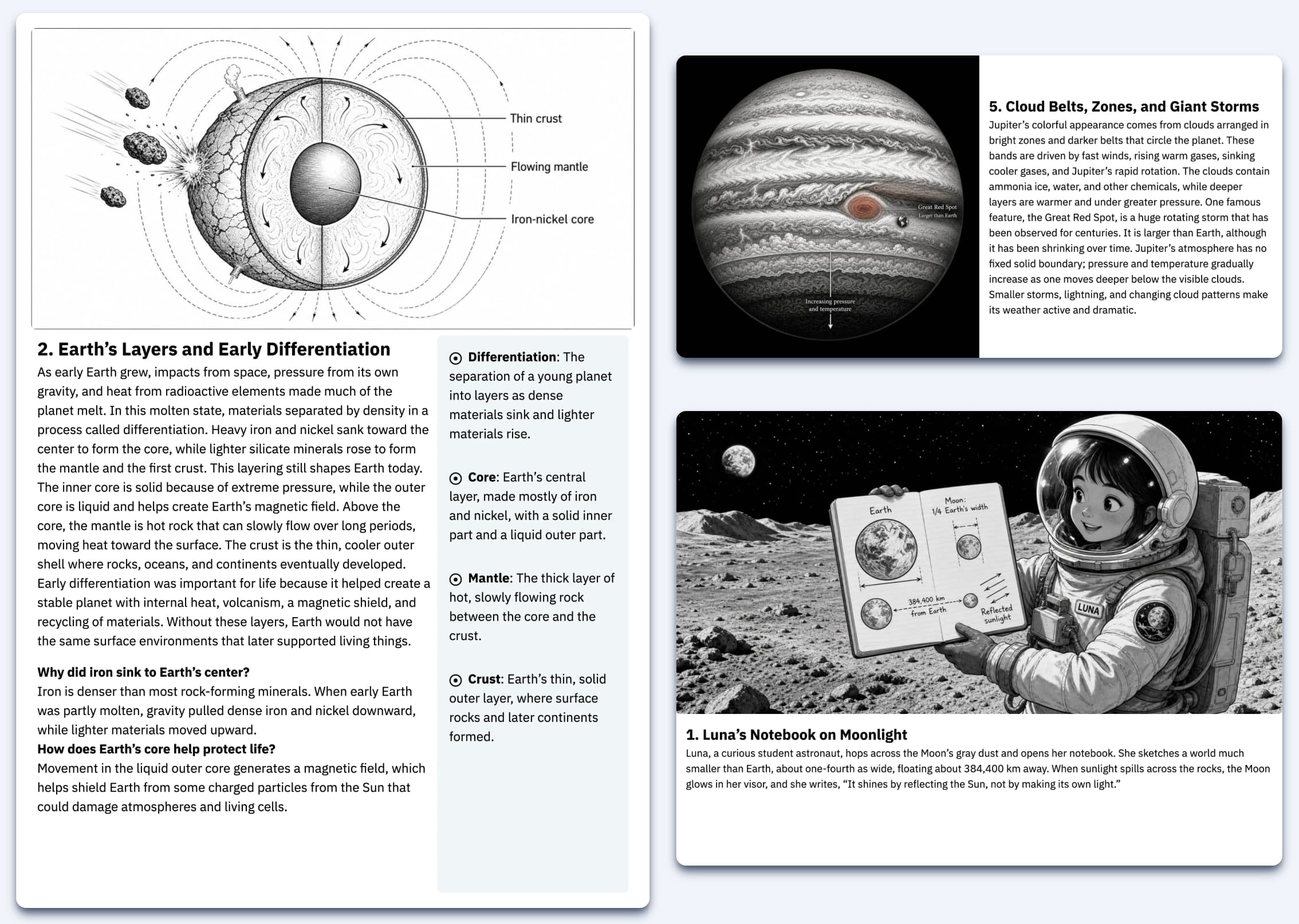
5. Cloud Belts, Zones, and Giant Storms
Jupiter’s bright zones and dark belts are shaped by rapid rotation, jet streams, and rising and sinking gases. Its ammonia- and water-rich clouds form above hotter, high-pressure layers. The Great Red Spot is a centuries-old storm larger than Earth but shrinking. With no solid surface, Jupiter has constant storms, lightning, and shifting clouds.Jupiter’s bright zones and dark belts are shaped by rapid rotation, jet streams, and rising and sinking gases. Its ammonia- and water-rich clouds form above hotter, high-pressure layers. The Great Red Spot is a centuries-old storm larger than Earth but shrinking. With no solid surface, Jupiter has constant storms, lightning, and shifting clouds.Jupiter’s bright zones and dark belts are shaped by rapid rotation, jet streams, and rising and sinking gases. Its ammonia- and water-rich clouds form above hotter, high-pressure layers.
Fullscreen
6. Deep Layers and Jupiter’s Hidden Heat
Below Jupiter’s clouds, pressure rises so dramatically that hydrogen changes from a gas into a dense liquid. Far deeper down, scientists think hydrogen becomes metallic, meaning it can conduct electricity like a metal. Motion in this layer likely helps create Jupiter’s enormous magnetic field, which traps charged particles and produces intense radiation around the planet. Jupiter also releases more heat than it receives from the Sun. Much of this energy is leftover heat from its formation and heat produced as the planet slowly contracts under gravity. At the center may be a diluted core containing heavier elements, but its exact size and structure are still being investigated through spacecraft measurements and computer models.
Fullscreen
7. The Great Red Spot and Jupiter’s Stormy Atmosphere
Jupiter’s vast hydrogen-helium atmosphere is divided into pale zones and darker belts, created as warm gases rise, cool, sink, and race around the rapidly rotating planet in powerful jet streams. South of the equator, the Great Red Spot is a giant oval storm roughly Earth-sized that has raged for centuries, though it is gradually shrinking. With no solid surface beneath it to disrupt its winds, the storm is sustained by Jupiter’s turbulent atmospheric circulation.
Fullscreen
8. A Vast Magnetic Field and Brilliant Auroras
Jupiter has the strongest planetary magnetic field in the Solar System. Deep inside the planet, extreme pressure turns hydrogen into an electrically conducting liquid called metallic hydrogen. Movement in this material acts like a huge natural generator, producing a magnetic field that stretches millions of kilometers into space. This magnetic bubble, called the magnetosphere, traps charged particles and creates dangerous radiation belts. At Jupiter’s poles, charged particles crash into gases high in the atmosphere and produce glowing auroras. These lights are far more powerful than Earth’s northern and southern lights. Jupiter’s volcanic moon Io also feeds particles into the magnetic field, helping make the auroras especially energetic.
Fullscreen
9. Jupiter’s Faint Ring System
Although Saturn is famous for its bright rings, Jupiter also has a ring system. Jupiter’s rings are faint, thin, and difficult to see from Earth because they are made mostly of tiny dust particles rather than large pieces of ice. The main ring lies close to the planet and is surrounded by a broad, hazy halo. Farther out are delicate gossamer rings, which are named for their extremely thin, web-like appearance. Scientists think the dust comes mainly from small inner moons such as Metis, Adrastea, Amalthea, and Thebe. When meteoroids strike these moons, impacts blast dust into space. Jupiter’s gravity and magnetic environment then shape the material into rings.
Fullscreen
10. The Galilean Moons: Four Different Worlds
Jupiter’s four largest moons—Io, Europa, Ganymede, and Callisto—are called the Galilean moons because Galileo Galilei observed them in 1610. Each is a distinct world. Io is covered with active volcanoes, powered by gravitational stretching caused by Jupiter and neighboring moons. Europa has a bright icy crust and likely holds a salty ocean beneath it, making it a leading place to search for conditions that could support life. Ganymede is the largest moon in the Solar System, even larger than Mercury, and it has its own magnetic field. Callisto is heavily cratered, preserving a record of ancient impacts, and may also contain a deep underground ocean.
Fullscreen
11. Jupiter’s Smaller Moons and Their Clues
Jupiter has dozens of smaller moons in addition to its four large Galilean moons. Many are irregularly shaped objects that were likely captured by Jupiter’s powerful gravity long ago instead of forming beside the planet. Several travel in tilted, distant, or backward paths, called retrograde orbits, which supports the capture idea. The inner moons are especially important because they are connected to Jupiter’s dusty rings. Small moons such as Metis and Adrastea orbit close to the cloud tops, while Amalthea and Thebe supply material to the outer rings. Studying these moons helps scientists understand how gravity captures objects, how impacts create dust, and how the early Solar System was assembled from many smaller bodies.
Fullscreen
12. Spacecraft Exploring Jupiter’s Future
Space missions have transformed Jupiter from a bright point in the sky into a detailed scientific laboratory. Pioneer and Voyager spacecraft made early close flybys, revealing the rings, active volcanoes on Io, and complex cloud patterns. The Galileo orbiter studied Jupiter and its moons from 1995 to 2003, while its atmospheric probe sampled the giant planet’s clouds. NASA’s Juno spacecraft arrived in 2016 and has mapped Jupiter’s magnetic field, examined its deep atmosphere, and photographed its polar cyclones. Future exploration focuses strongly on icy moons. NASA’s Europa Clipper will investigate Europa’s ice shell and ocean environment, and ESA’s JUICE mission will study Ganymede, Europa, and Callisto to better understand their potential hidden oceans.
Fullscreen
Learning materials for your class.
Create printables and presentations with beautiful and accurate images. Engage with your class while communicating complex concepts in science and technology